The short answer: for a trip to Morocco, buy and install a travel eSIM before you fly, activate it when you land, and you are online in seconds with no paperwork. A local Maroc Telecom, Orange or inwi SIM is cheap, but it requires an in-person passport check at a shop — the clerk records your passport details and, in many cases, takes your photo — and there is no way to complete that step remotely. The travel eSIM skips the counter entirely: no line at the airport kiosk, no language barrier, no waiting on shop hours. You clear immigration, flip on the eSIM you already installed, and you’re on Morocco’s network before you reach baggage claim.
What you’ll learn on this page: the four things that quietly trip up Americans flying into Marrakech or Casablanca — (1) why you should set up your eSIM before you land, (2) how a travel eSIM sidesteps Morocco’s in-person passport-and-photo SIM registration entirely, (3) what your AT&T International Day Pass ($12/day) or Verizon TravelPass ($10/day) actually costs across a week in Morocco and where the eSIM wins, and (4) why WhatsApp and FaceTime work fine here today — with a note on the brief 2016 ban that has long since been lifted. Payments (cash is still king) and a city-by-city coverage rundown are toward the bottom.
Morocco quietly became one of Africa’s mobile bright spots in 2025, and staying connected there is easier than most first-timers expect — once you get past the one bit of friction at the SIM counter. According to GSMA Intelligence, mobile is the primary way most Moroccans get online, and the country’s networks took a real leap this past year: after a nationwide 5G launch in November 2025, the Ookla Speedtest Global Index ranked Morocco the fastest mobile market in Africa, around a 124 Mbps median and roughly 39th in the world. This page is the version of the guide I’d hand an American friend flying in tomorrow.
- Rule #1 for Morocco: set up your eSIM before you land
- How a travel eSIM sidesteps Morocco’s passport-and-photo SIM paperwork
- No tourist IMEI rule to worry about in Morocco
- Will your U.S. phone even work? It’s about the bands
- What U.S. carriers actually cost in Morocco, and where the travel eSIM wins
- Best travel eSIMs for Morocco in 2026 — three worth considering
- Connectivity by destination — what to expect city by city
- WhatsApp, FaceTime and messaging in Morocco — it all works today
- Day-of-arrival checklist at Marrakech (RAK) or Casablanca (CMN)
- FAQ — the questions American travelers ask me most about connectivity in Morocco
- Can I just buy an eSIM after I land in Morocco?
- Do I need my passport to get a SIM in Morocco?
- Do I have to register my phone’s IMEI in Morocco?
- Should I use Verizon TravelPass or AT&T’s Day Pass instead of a travel eSIM?
- Will WhatsApp and FaceTime work in Morocco?
- Do I still need cash in Morocco, or can I pay by card?
- Can I hotspot my Morocco eSIM to my laptop or my partner’s phone?
- What’s the emergency number in Morocco?
- References and further reading
Rule #1 for Morocco: set up your eSIM before you land
Disclosure: This page contains affiliate links from which Cairnroam may earn a commission at no extra cost to you. Pricing and regulatory details are accurate as of July 2026, drawn from Morocco’s telecom regulator ANRT, GSMArena’s band data, Ookla’s Speedtest Global Index, the U.S. State Department, and my own testing. — Mara Whitlock
Here’s the practical rule: install and pay for your travel eSIM while you’re still on home Wi-Fi in the U.S. Unlike some countries, Morocco doesn’t block eSIM apps or their websites — you could buy one on arrival if you had to — but there’s simply no upside to waiting. Morocco has no India-style app-store block, so this is about convenience, not necessity. Do it at home and the only thing left to do on landing is toggle the line on.
The failure mode you’re avoiding is the alternative to an eSIM: you land at Marrakech (RAK) tired, join the queue at a SIM kiosk, hand over your passport while the clerk photographs you and keys in your details, and lose 20 minutes you didn’t have to. Buy the eSIM at home, install the line, and just flip it on after immigration — you’re online before anyone at the counter has finished their paperwork.
How a travel eSIM sidesteps Morocco’s passport-and-photo SIM paperwork
Every local Moroccan prepaid line requires identity registration. For a foreigner buying a Maroc Telecom, Orange or inwi SIM, that means an in-person passport check: you present your physical passport, the shop records your passport details, and — reported at many outlets — the clerk takes your photo to attach to the sale. A home-country driver’s license or ID card usually won’t do; it’s the passport or nothing. Morocco’s telecom regulator, ANRT, requires this SIM registration, and there’s no remote or app-based shortcut around the counter step. Airport SIM kiosks at Casablanca and Marrakech run long hours, and city shops are everywhere, so it’s not hard — it’s just an in-person errand.
A travel eSIM skips all of that. You’re not a customer of a Moroccan operator — you’re an inbound roaming subscriber on a line issued abroad, roaming onto a Moroccan host network. No shop visit, no passport handed across a counter, no photo taken. You trade Morocco’s low local per-gigabyte price for instant, paperwork-free activation. For most travelers on a one-to-three-week trip, that trade is a no-brainer.
No tourist IMEI rule to worry about in Morocco
If you’ve read my guides to other countries, you may be bracing for a phone-registration hoop. Morocco has no tourist-facing IMEI registration. The friction here is purely the in-person passport-and-photo step at the SIM shop — nothing to do with your handset’s serial number and nothing you need to file with the government. Using a travel eSIM sidesteps even the SIM-shop step entirely. One thing that does matter: if your phone is carrier-locked to a U.S. network, neither a local SIM nor a travel eSIM will work, so unlock it before you fly.
Will your U.S. phone even work? It’s about the bands
Morocco’s networks run on frequencies that almost every modern U.S.-market phone handles. The nationwide 4G baseline is Band 3 (1800 MHz) and Band 20 (800 MHz); cities add Band 7 (2600 MHz) for extra capacity; and the new 5G build uses n78 (3.5 GHz) as its main band. A late-model unlocked iPhone or Pixel supports all of these without issue. The phones that struggle are older or heavily carrier-locked U.S. Android models missing Band 20 — on those you may see weaker signal in the areas that lean on the 800 MHz layer. If your phone is more than four or five years old, check its band list before you rely on it, per the published Morocco band list.
Between the networks themselves: Maroc Telecom, Orange and inwi all launched 5G nationwide on the same day in November 2025, and coverage obligations phase in over the following years — so 5G is a city-and-highway story today, not yet a deep-rural one. As a traveler you don’t pick directly; your travel eSIM roams onto one of the three. That’s why coverage is excellent in the cities and along main routes, and thins out only when you head deep into the desert or high into the Atlas.
What U.S. carriers actually cost in Morocco, and where the travel eSIM wins
Morocco is on every major U.S. carrier’s roaming map, so your phone will attach the moment you land. The catch is the price and, on some plans, the speed.
| Option | Cost for a 7–10 day Morocco trip | Speed | Notes |
|---|---|---|---|
| Verizon TravelPass | $70–$100 (7–10 × $10) | Full plan speed | Counts against your high-speed allotment; hotspot included |
| AT&T International Day Pass | $84–$120 (7–10 × $12) first line; $6/day additional | Full plan speed | Same plan as home; hotspot included |
| T-Mobile (Experience / Magenta MAX baseline) | $0 | Data included on top plans; throttled after allowance, then 256 Kbps | Fine for messaging; older plans painful for video |
| Saily Morocco (representative 5 GB plan) | ~$15–$20 (verify at purchase) | Full 4G/5G | Activate on landing; keeps U.S. line free for SMS 2FA; ad/malware block |
| Nomad Morocco (representative 5 GB plan) | ~$20–$25 (verify at purchase) | Full 4G/5G | Rides the Orange network in Morocco; easy mid-trip top-up |
| esim4travel Morocco | Budget tier (verify at purchase) | Full 4G/5G | Cheapest of the three when you just need maps + messaging |
The headline: roughly $15–$25 for a week of data on a travel eSIM versus $70–$120 on Verizon or AT&T. A day pass makes sense only for a single overnight where you need data for an hour — otherwise the eSIM is dramatically cheaper. Before you go, it’s also worth noting that the U.S. State Department currently lists Morocco at Level 2 (Exercise Increased Caution) — standard for the region, but worth a glance before you fly.
Best travel eSIMs for Morocco in 2026 — three worth considering
On-network performance is broadly similar among these because they all roam onto one of Morocco’s three operators under the hood. What differs is price, package shape, and extras. All three let you keep your U.S. number live for SMS two-factor codes while data runs over the eSIM.
- Saily — my default pick for Morocco. Built by the Nord Security (NordVPN) team, with ad- and malware-blocking built into the app. Clean iOS and Android setup and reliable activation on landing. Use coupon CAIRNR6205 at checkout. The cheap-and-clean choice.
- Nomad — priced a touch above Saily with slightly different bucket sizes, and research indicates Nomad rides the Orange network in Morocco, which has solid urban coverage. The app makes topping up mid-trip painless. Coupon ILEXBDNSXSBA knocks a little off your first order.
- esim4travel — the budget option. Fewer frills, but when all you need is Google Maps, WhatsApp and the occasional ride, it’s the cheapest way to stay connected across a two-week Morocco trip. A cairnroam coupon is coming soon.
Whichever you choose, buy it before you fly (see Rule #1) and size the data to how much you actually stream. For a maps-and-messaging traveler, 5 GB covers a week comfortably; if you’re posting a lot of video from Marrakech or the dunes, jump to a 10–20 GB or unlimited-style plan.
Connectivity by destination — what to expect city by city
Marrakech
Blanket 5G across the modern city and strong LTE through the medina and around Jemaa el-Fnaa. The predictable weak spot is deep inside the tightest souk lanes and thick-walled riads, where signal thins — step toward an open courtyard or the square and it snaps back. Marrakech (RAK) airport has usable Wi-Fi, but your eSIM will be faster the moment you land.
Casablanca
Morocco’s business capital is among the best-connected places in the country — dense 5G, strong café Wi-Fi, and reliable coverage along the tram corridor. Casablanca (CMN) is the main international gateway, and the SIM kiosks here run long hours if you ever do need a local line.
Fes
The new city has full 5G/LTE; the ancient medina of Fes el-Bali is the classic gotcha, a maze of narrow, high-walled lanes where GPS wanders and signal drops in the deepest stretches. Download an offline map before you dive in, and pin your riad so you can navigate back out.
Chefchaouen
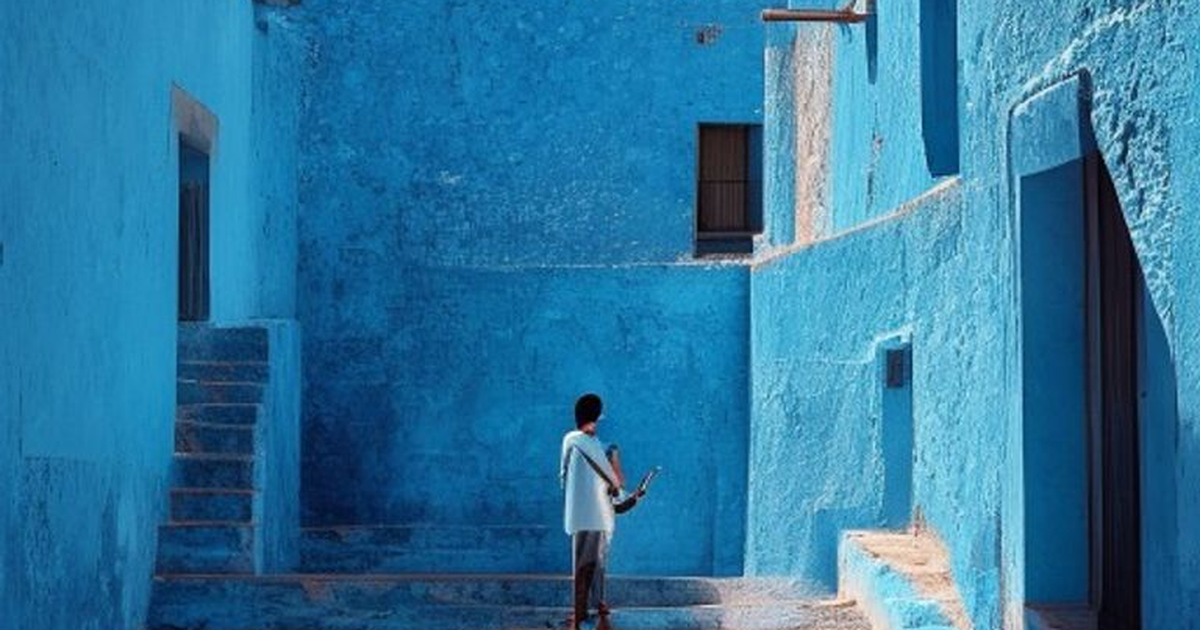
The blue town in the Rif mountains is well covered on LTE in and around the medina — fine for uploading all those blue-wall photos. Head up the surrounding hills for the classic viewpoint and you’ll notice the signal fade as you climb, so grab your shots’ geotags while you still have bars.
The Sahara and Merzouga
This is where coverage genuinely runs out. Towns like Merzouga and Erfoud have LTE, but ride a camel out to a desert camp among the Erg Chebbi dunes and you should expect to be offline for stretches. Treat it like off-grid travel: download offline maps, tell your riad or tour operator your plan, and don’t count on a stable video call from the dunes.
The Atlas Mountains
Mountain towns and trailheads in the High Atlas often surprise you with a usable signal, but deep valleys and the trekking routes up toward Toubkal drop to nothing for hours. Treat it like hiking in the rural Rockies: download everything offline the night before, and share your route with someone who isn’t on the mountain with you.
WhatsApp, FaceTime and messaging in Morocco — it all works today
Morocco does not currently block VoIP. WhatsApp voice and video, FaceTime, Messenger, Signal, Telegram, Zoom and Google Meet all work normally on Moroccan networks. There’s a bit of history worth knowing: in January 2016, ANRT blocked free VoIP calling on apps like Skype, WhatsApp and Viber, which set off a large public backlash. The regulator lifted that ban on 25 October 2016, and it has stayed lifted ever since. So if an old blog post scares you about “no WhatsApp in Morocco,” it’s out of date.
This matters practically because WhatsApp is the de-facto tool in Morocco — riads, drivers and tour operators overwhelmingly coordinate over WhatsApp rather than email or phone calls. Having a data line that keeps WhatsApp live is, for most travelers, the single most useful thing your eSIM does. Set it up, message your riad on arrival, and you’re plugged into how the country actually communicates.
Day-of-arrival checklist at Marrakech (RAK) or Casablanca (CMN)
- Before boarding in the U.S.: install the Saily, Nomad or esim4travel app on home Wi-Fi and buy a 5 GB Morocco package (representative ~$15–$20; verify at purchase). Apply your coupon and save the QR code locally.
- During descent: open the app and tap “Install line” so the eSIM loads into Settings → Cellular. Leave airplane mode on for now.
- After immigration: turn airplane mode off, wait for the Moroccan network to attach, then set the travel eSIM as your Cellular Data line. Keep your U.S. line on for SMS but switch its Data Roaming off.
- Open WhatsApp and message your riad or driver to confirm data is live. If it doesn’t connect in 30 seconds, reboot — that fixes it almost every time.
- Get some cash. Dirham is still king in Morocco, especially in the medina and souks. ATMs in arrivals cap withdrawals around 2,000 MAD (about $200) per transaction, so plan a couple of pulls for a longer trip.
- Save the emergency numbers: 19 for police, 15 for ambulance, and 112 from any mobile (the GSM standard), which connects you to emergency services on any network — including your roaming travel eSIM.
Arrival day does not look the same across North Africa. In Tunisia you have to clear the currency step first — the dinar cannot legally be brought into the country, so there is no way to pay for a local SIM until you have exchanged cash at the airport. The Tunisia eSIM guide lays out that order of operations.
FAQ — the questions American travelers ask me most about connectivity in Morocco
Can I just buy an eSIM after I land in Morocco?
Yes — Morocco doesn’t block eSIM apps or their websites, so you technically can. But there’s no reason to wait: set it up on home Wi-Fi before you fly so the only thing left on landing is flipping the line on. That’s Rule #1.
Do I need my passport to get a SIM in Morocco?
For a local SIM, yes — Moroccan operators register every line, so buying a Maroc Telecom, Orange or inwi prepaid means an in-person passport check and, often, a photo taken at the shop. A travel eSIM skips that entirely, because you’re roaming on a line issued abroad rather than opening a Moroccan account.
Do I have to register my phone’s IMEI in Morocco?
No. Morocco has no tourist IMEI registration requirement. The only friction is the in-person passport-and-photo step for a local SIM — and a travel eSIM sidesteps even that.
Should I use Verizon TravelPass or AT&T’s Day Pass instead of a travel eSIM?
For anything longer than two or three days, no. TravelPass runs $10/day and AT&T’s International Day Pass $12/day, so a week is $70–$84; a travel eSIM for the same trip is roughly $15–$25 total. For a single overnight layover where you need data for an hour, a day pass is fine — turn it on, turn it off the next morning.
Will WhatsApp and FaceTime work in Morocco?
Yes, fully. Morocco does not currently block VoIP, so WhatsApp voice/video, FaceTime, Signal and the rest all work normally. There was a temporary ban in 2016, but ANRT lifted it on 25 October 2016 and it has stayed lifted since. WhatsApp is how riads and tours coordinate, so keeping it live is the most useful thing your eSIM does.
Do I still need cash in Morocco, or can I pay by card?
Bring cash. Dirham is still the everyday currency, especially in the medina, souks and small shops; hotels and larger stores take cards. ATMs cap withdrawals around 2,000 MAD (about $200) per transaction, so budget a couple of pulls for a longer stay.
Can I hotspot my Morocco eSIM to my laptop or my partner’s phone?
On most plans, yes — Saily, Nomad and esim4travel generally allow personal hotspot, though tethering allowances vary by plan, so check the plan details. Size up your data if you’ll tether a laptop for work.
What’s the emergency number in Morocco?
Dial 19 for police and 15 for an ambulance. From any mobile you can also dial 112, the GSM-standard emergency number, which connects on any network — including a roaming travel eSIM — even without your own signal.
References and further reading
- U.S. Department of State — Morocco Travel Advisory (Level 2): the current U.S.-government advisory.
- Ecofin Agency / Ookla — Africa’s fastest mobile internet in 2025: Morocco’s ~124 Mbps median and #39 global rank.
- Ecofin Agency — Morocco launches 5G nationwide (7 Nov 2025): the simultaneous three-operator 5G rollout.
- Morocco World News — Morocco officially launches 5G nationwide: 5G licenses and operator spectrum.
- GSMArena — Morocco network bands: the national 2G/3G/4G band list (B3/B20).
- Brookings — Morocco reverses its VoIP app ban: the January 2016 block and its October 2016 reversal.
- Africanews — Morocco lifts ban on free mobile internet calls (2016): the lifting of the VoIP ban.
- U.S. Trade.gov — Morocco Telecommunications country guide: market structure and the three-operator landscape.
Questions or a correction? Reach us through our contact form.
Last updated: 2026-07-17